Perseverance plays a vital role in navigating the challenges we encounter in school, at work, and throughout daily life. Yet despite broad agreement among educators, employers, and researchers about its importance, there is still no shared understanding of what “perseverance” actually means.
In our latest ETS report, “Keep Calm and Carry On: A Conceptual Framework for Perseverance,” we found that the term is often used interchangeably with a range of related concepts, such as work ethic, grit, and conscientiousness. If perseverance is indeed as essential as many assert, then it’s important that we develop valid and effective ways to measure and cultivate it in both students and adults. To do that, we must first establish a clear and comprehensive definition of what we mean when we talk about “perseverance” as a skill.
Getting There: Defining Perseverance
To better understand and define perseverance in a way that could inform efforts to measure and grow this skill, we need to identify common themes across research and practice. Throughout our work, one important trend we uncovered is that people from various backgrounds and levels of expertise generally think of perseverance as “the way that we respond to adversity.” Given this, we also considered specifically how individuals might respond to such hardships. As a result, we defined perseverance as one’s emotional and effortful response to common challenges or obstacles.
Perseverance and Emotional Resilience
Throughout our work, we identified two main factors that describe the reactions individuals tend to exhibit when faced with difficulties.
First, people might respond to obstacles based on their emotional reaction:
- They may become frustrated, angry, nervous, dejected, or experience any other debilitating emotions.
- In contrast, individuals may remain composed, confident, or even excited at the prospect of overcoming the challenges in front of them.
This contrast implies a scale of reactions we call emotional resilience. This factor is important because research shows that stressors can harm our well-being and psychological health. Research has also demonstrated that poor emotional responses to obstacles can negatively impact memory, as well as satisfaction and performance at school or work. Specifically, adverse emotional responses can influence academic and workplace performance, in terms of quality and quantity, and even workplace safety. This suggests that emotional resilience is critical for supporting positive academic and workplace outcomes like higher productivity, graduation rates, and job retention.
Perseverance and Effortful Persistence
Second, people might respond to obstacles based on their effort level:
- Some individuals might disengage with the task at hand, working more slowly than usual or quitting entirely.
- In contrast, others tend to maintain strong effort when challenged or even work harder than they normally might.
We call this factor effortful persistence. Prior research suggests that effort level is related to improved goal attainment, problem-solving, and productivity. This means that effortful persistence can have a positive impact on various life outcomes, such as economic mobility and even physical and psychological health.
Four Examples of Perseverance Responses
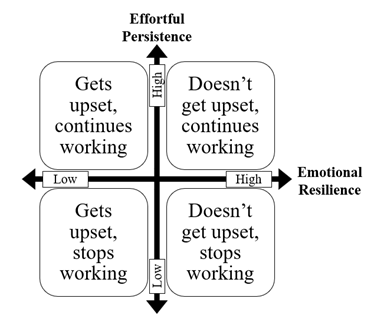
- High emotional resilience, high effortful persistence (top right): this is the ideal response, an individual who remains calm and continues working hard when faced with challenges.
- Low emotional resilience, low effortful persistence (bottom left): this is the least desired response, someone who becomes upset and stops working when encountering difficulties.
- Low emotional resilience, high effortful persistence (top left): someone who may experience detrimental emotions but keeps working on a difficult task. These individuals may work harder because they are motivated to relieve their distress.
- High emotional resilience, low effortful persistence (bottom right): someone who might calmly and logically disengage from their tasks when faced with obstacles.
More research is needed to pinpoint how these latter two types of responses might influence outcomes, but it is likely that they would be linked to relatively poorer effects on well-being, productivity, and other areas. While this diagram is representative in nature, it demonstrates how people might respond to challenges. In reality, it may not be as simple as neatly categorizing individuals into one of the four groups in the diagram. One could imagine individuals scoring anywhere on a scale from 0 to 100 on each of our two factors, for example.
Keep Calm and Carry On
The two factors in our perseverance definition align with the familiar phrase “keep calm” (emotional resilience) “and carry on” (effortful persistence). This phrase was introduced by the United Kingdom government in 1939 to raise the population’s morale in the face of the impending Second World War. In the decades since then, little has changed regarding perseverance’s value in the face of hardships across various life areas. The recent COVID-19 pandemic is a stark reminder that large-scale, drastic events can significantly disrupt our lives. Beyond these rare global events, there are more common challenges such as job loss, health issues, financial debt, and caretaking stress that further reinforce the importance of perseverance. Our report provides more detail to help distinguish perseverance from other concepts, including work ethic, grit, and conscientiousness. Together, these distinctions clarify why perseverance remains a uniquely powerful resource for navigating adversity, not just by enduring challenges, but by adapting thoughtfully and persistently in response to them.